
AI App Builder vs Freelancer vs Agency: Which One Should You Choose in 2026?
Building software has never looked easier. A founder can now open an AI app builder, describe an idea, and generate a working interface in minutes. A business owner can hire a freelancer from anywhere in the world. An agency can take over the full project and manage design, development, and delivery.
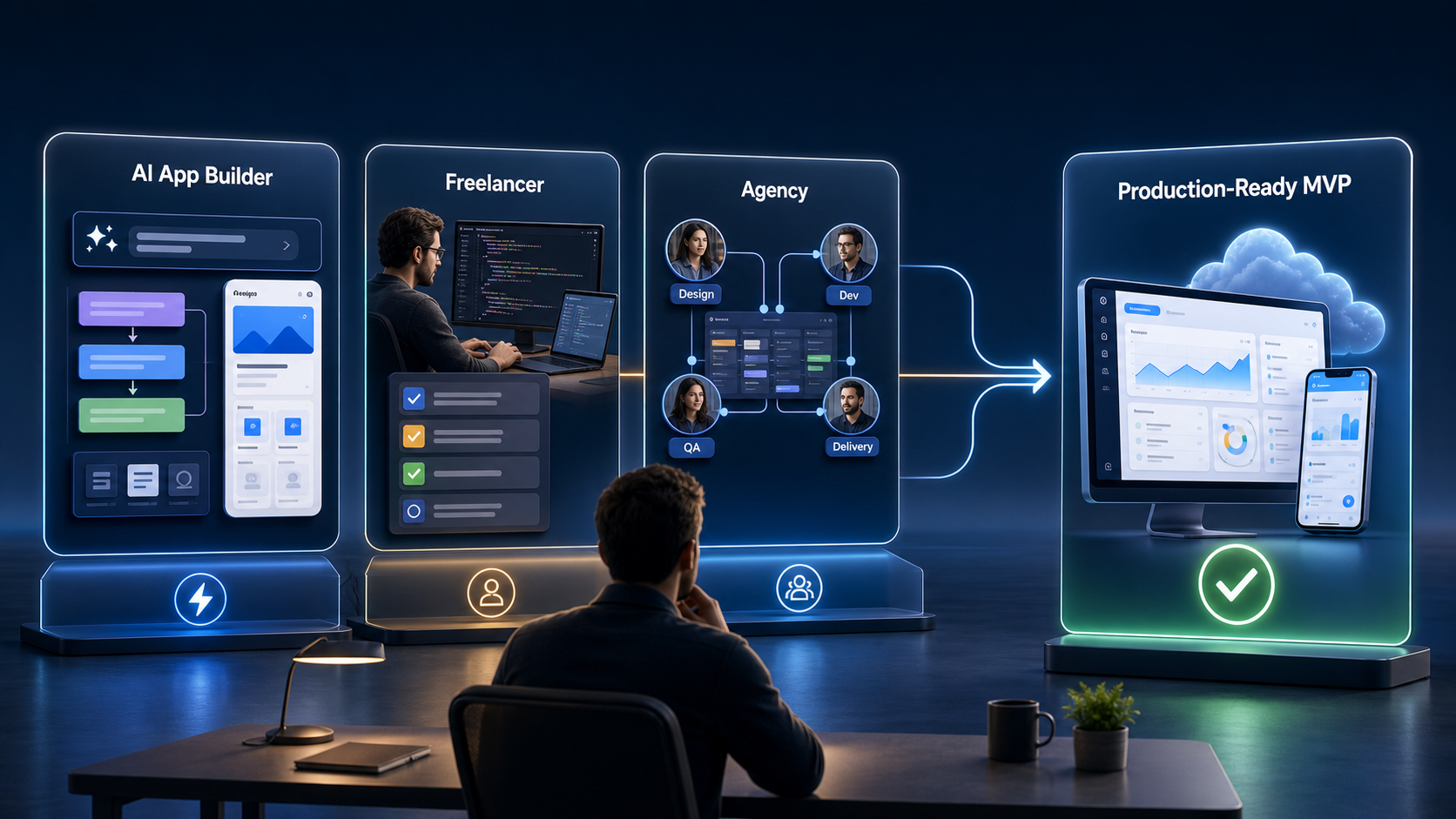
Building software has never looked easier.
A founder can now open an AI app builder, describe an idea, and generate a working interface in minutes. A business owner can hire a freelancer from anywhere in the world. An agency can take over the full project and manage design, development, and delivery.
On paper, all three options can help you build a product.
But the real question is not “Can they build something?”
The real question is: which option can help you build the right product, at the right speed, with the right quality, without creating problems later?
For startups, agencies, and business owners, choosing between an AI app builder, a freelancer, or an agency is now one of the most important early decisions. The wrong choice can waste months, burn budget, create technical debt, or leave you with a product that looks good but cannot scale.
Let’s break down each option clearly.
Option 1: AI App Builders
AI app builders are tools that let you create software using natural language prompts. You describe what you want, and the platform generates screens, workflows, databases, and code.
They are fast, exciting, and useful for early exploration.
If you want to test an idea visually, create a quick prototype, or show a rough concept to a potential customer, an AI app builder can be a good starting point. It lowers the barrier to software creation and helps non-technical founders move faster.
The strengths are clear:
Very fast initial output
Low starting cost
Good for prototypes and demos
Useful for testing product ideas
No need to hire a developer immediately
But there are limits.
Many AI app builders are better at creating visible progress than production-ready software. The product may look complete, but important parts can be weak: architecture, security, testing, deployment, performance, permissions, and long-term maintainability.
Founders also need to watch for hidden costs like credits, tokens, platform limits, lock-in, and difficulty exporting or maintaining the code later.
AI app builders are best when your goal is learning, not launching.
Use them when you need a quick prototype. Be careful when you need a real product that customers will depend on.
Option 2: Freelancers
Freelancers are a common choice for founders and small businesses because they feel flexible and affordable.
A good freelancer can move quickly, understand your requirements, and build specific features without the cost of a full agency. If your scope is clear and you know how to manage the project, a freelancer can be a strong option.
Freelancers are useful when:
You have a small feature to build
You already know the product requirements
You have someone technical to review the work
You need flexibility
Your budget is limited
The challenge is that freelancers usually work as individuals. One person may not cover product planning, UI/UX, frontend, backend, database design, testing, DevOps, security, and documentation at the same level.
This creates a management burden for the founder.
You may need to explain the product, write detailed requirements, review quality, manage timelines, test the product, handle deployment, and coordinate fixes. For a non-technical founder, that can become stressful very quickly.
The other risk is dependency. If one freelancer builds your entire MVP and later becomes unavailable, your product can become difficult to maintain.
Freelancers work best when the project is clearly defined and someone on your side can manage technical quality.
Option 3: Agencies
Agencies are usually the most structured option.
A good agency brings a team: product managers, designers, developers, QA testers, and project leads. They can handle larger builds, more complex requirements, and professional delivery.
Agencies are useful when:
The product is complex
You need design, strategy, and development together
You have a larger budget
You want a managed process
You need multiple specialists involved
The advantage is reliability. Agencies usually have systems, communication rhythms, delivery checkpoints, and specialized people for each part of the project.
But agencies also come with trade-offs.
They can be expensive. They may take longer to start. They may overbuild the first version. Some agencies add process where a startup actually needs speed. For early-stage founders, this can create a mismatch: the agency wants a full project, while the founder needs a focused MVP to validate demand.
Agencies are best when the budget is available, the scope is mature, and the product needs a high-touch team.
For early MVPs, they may be more than you need.
The Core Difference
Here is the simplest way to compare the three:
Option | Best For | Main Strength | Main Risk |
|---|---|---|---|
AI app builder | Prototypes and quick demos | Speed | Fragile or incomplete product |
Freelancer | Small builds or defined tasks | Flexibility | Quality and dependency risk |
Agency | Complex custom projects | Full-service delivery | Cost and slower execution |
None of these options is wrong.
The problem is that many founders choose based only on price or speed. That is dangerous because an MVP is not just a screen. It is the foundation for validation, customer conversations, investor confidence, and future development.
If the foundation is weak, everything after launch becomes harder.
Where Paranu Fits
Paranu is built for founders, agencies, and business owners who want the speed of AI without the uncertainty of managing AI tools, freelancers, or traditional agency workflows.
It gives you a fourth path: AI-orchestrated software delivery.
That means you do not just get generated code. You get a complete delivery process.
Paranu helps turn your idea into:
Product requirements
User flows
Wireframes
Acceptance criteria
System architecture
Frontend and backend development
Testing
Security checks
Deployment
Documentation
Full code ownership
Instead of asking a founder to become a product manager, developer, QA tester, and DevOps lead, Paranu handles the software lifecycle as one connected process.
You describe the idea. Paranu structures it, builds it, tests it, deploys it, and gives you ownership of the final product.
Why This Matters for Startups
Startups do not need bloated software. They need focused software that helps them learn faster.
A good MVP should answer important questions:
Do users want this?
Will they pay for it?
Is the workflow useful?
Can this become a real business?
What should we build next?
To answer those questions, the MVP must be usable by real people. It does not need every feature, but it does need to work properly.
This is where Paranu helps startups move faster without sacrificing quality.
You can launch a focused product without waiting months to find a technical co-founder, without managing freelancers, and without paying traditional agency prices for an overbuilt version one.
Why This Matters for Agencies
Agencies also benefit from this model.
Many agencies are under pressure to deliver faster because clients now expect AI-speed execution. But shipping raw AI-generated work can damage trust if the product breaks later.
Paranu gives agencies a way to expand delivery capacity while maintaining professional standards. It helps with planning, build execution, testing, and deployment, so agencies can take on more client work without relying only on hiring more developers.
For agencies, Paranu is not just a tool. It can become a delivery engine.
How to Choose the Right Path
Choose an AI app builder if you only need to explore an idea or create a quick demo.
Choose a freelancer if you have a small, well-defined task and someone technical can review the output.
Choose an agency if you have a larger budget, a complex scope, and need a full-service team.
Choose Paranu if you want to build a real MVP or software product with AI-speed execution, structured delivery, testing, deployment, and ownership.
That is the key distinction.
Paranu is not replacing the need for good product thinking. It is removing the operational burden of turning that thinking into production-ready software.
Final Thought
In 2026, building software is not only about who can write code.
AI can write code. Freelancers can write code. Agencies can write code.
The harder problem is turning an idea into a reliable product that real users can trust.
That requires planning, architecture, testing, deployment, security, documentation, and ownership. It requires a complete delivery system, not just a builder or a developer.
For startups, agencies, and business owners who want to move fast without creating future technical problems, Paranu offers a better way to build.
You bring the idea.