
Vibe Coding vs Production-Ready Software: What Founders and Agencies Need to Know
Understand the difference between vibe coding and production-ready software, and how Paranu helps founders and agencies launch reliable AI-built products.
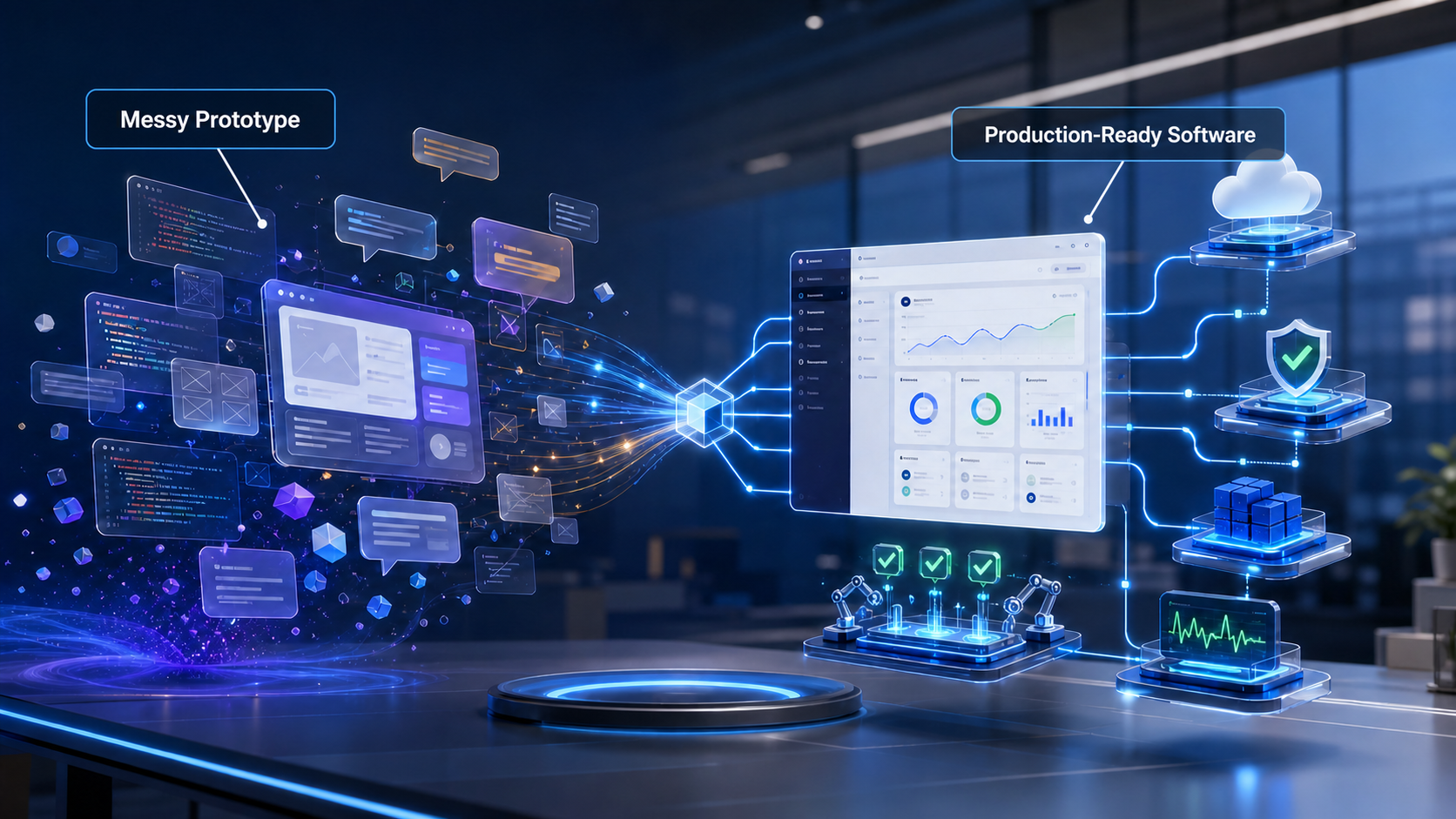
Vibe coding has made software feel magical.
You describe an idea, an AI tool generates code, a screen appears, and within minutes you have something that looks like a product. For founders, agencies, and business owners, this is exciting because the distance between idea and prototype has collapsed.
But here is the part many people discover later: a working demo is not the same as production-ready software.
Vibe coding is useful for exploring ideas. It can help you visualize a product, test a concept, and move faster in the early stages. But when real users, real payments, real data, real security, and real business operations enter the picture, the standard changes.
That is where production-ready software matters.
And that is the difference Paranu is built around.
What Is Vibe Coding?
Vibe coding is the practice of building software by describing what you want in natural language and letting AI generate large parts of the application.
Instead of writing every line manually, the builder gives prompts like:
“Create a dashboard for agency clients.”
“Add login and user roles.”
“Build a booking flow with payments.”
“Make the design look more premium.”
The AI responds with code, UI, database logic, or suggested fixes. This can be incredibly fast, especially for prototypes, internal tools, landing pages, dashboards, and simple MVPs.
For non-technical founders, vibe coding feels empowering. For developers, it can remove repetitive work.
For agencies, it can speed up first drafts and client demos.
But vibe coding also has a limit: it often optimizes for visible progress, not long-term reliability.
The Demo Trap
The biggest risk with vibe coding is that it creates confidence too early.
A product may look complete because the interface works. Buttons click. Pages load. Data appears on the screen. The founder feels close to launch.
But underneath, the product may still have hidden problems:
Weak architecture
Inconsistent code structure
Missing edge-case handling
Poor security controls
No proper test coverage
Fragile integrations
Unclear deployment setup
Database issues
Performance problems
Difficult handover to future developers
This is the demo trap.
The software looks ready because the first user journey works. But production is not about the first perfect journey. Production is about what happens when hundreds or thousands of imperfect journeys happen at once.
Users enter unexpected data. Payments fail. APIs go down. Permissions need to be enforced. Admins need audit trails. The app must handle errors gracefully. The system must be maintainable after launch.
A prototype does not need to survive all of that.
Production-ready software does.
What Production-Ready Software Actually Means
Production-ready software is software that can be safely used by real people in a real business environment.
It is not just about whether the code runs. It is about whether the product is stable, secure, scalable, testable, and maintainable.
A production-ready application usually includes:
Clear product scope and acceptance criteria
Solid system architecture
Secure authentication and permissions
Reliable backend logic
Clean database design
Proper error handling
Automated testing
Security checks
Performance review
Deployment setup
Monitoring or operational readiness
Documentation
Full code ownership and handover
This is why building real software is not just a coding problem. It is a lifecycle problem.
The code is only one part of the system.
Why Vibe Coding Alone Is Risky for Startups
For startups, speed matters. But so does trust.
If you are validating an idea, a quick AI-generated prototype can be useful. It helps you see the product, explain it to others, and collect early feedback.
But if you are launching to customers, pitching investors, onboarding businesses, or processing sensitive data, the expectations change.
A startup MVP should not be overbuilt, but it should be dependable. If the product breaks during a customer demo, loses data, exposes private information, or becomes impossible to modify later, the cost is not just technical. It affects credibility.
Founders should be especially careful about three things.
First, ownership. If your product works, you need to own the code, infrastructure, and deployment path. Otherwise, scaling or handing it to a future engineering team becomes painful.
Second, quality. AI can generate code quickly, but someone still needs to verify whether that code is safe, maintainable, and aligned with the product goal.
Third, continuity. A product is not done when the first version launches. You will need changes, fixes, user feedback, and new features. If the foundation is messy, every next step becomes slower.
Why Vibe Coding Alone Is Risky for Agencies
Agencies face a different version of the same problem.
Clients increasingly expect faster delivery because AI tools have changed perceptions. They see AI demos online and assume software should now be cheap, instant, and effortless.
That creates pressure on agencies.
Vibe coding can help agencies create faster mockups and prototypes, but client delivery requires a higher standard. Agencies are responsible for reliability, timelines, brand trust, and long-term client relationships.
If an agency ships a fragile AI-generated product, the client does not blame the tool. They blame the agency.
This is why agencies need more than fast generation. They need repeatable delivery, quality control, testing, documentation, and clean handover.
The real opportunity for agencies is not to replace their process with vibe coding. It is to upgrade their delivery model with AI while keeping professional standards intact.
The Real Difference: Fragments vs Systems
Vibe coding is good at generating fragments.
A login screen. A dashboard. A settings page. A database query. A payment flow. A piece of frontend logic.
But a production application is a system.
All the pieces must work together. The frontend must match the backend. The database must support the workflows. The permissions must protect the right data. The tests must confirm expected behavior. The deployment must be stable. The owner must be able to continue improving the product after launch.
This is the core difference.
Vibe coding asks: “Can we generate this quickly?”
Production-ready delivery asks: “Will this work correctly, securely, and reliably when the business depends on it?”
How Paranu Bridges the Gap
Paranu is designed for founders, agencies, and business owners who want the speed of AI without the uncertainty of raw AI-generated software.
Instead of giving you disconnected code fragments and asking you to manage the rest, Paranu handles the software lifecycle end to end.
It starts with your idea. You describe what you want in plain language. Paranu turns that into a structured product specification, including user flows, wireframes, acceptance criteria, and architecture decisions.
Then the build happens through an AI-orchestrated delivery process. Planning, coding, testing, security, DevOps, and deployment are treated as connected stages, not separate afterthoughts.
You do not just receive a prototype. You review a live, working product. You can test it, share it, request changes, and approve only when it matches the agreed outcome.
Once approved, you get full ownership: source code, Git export, infrastructure access, and documentation.
That is the difference between generating software and delivering software.
When Should You Use Vibe Coding?
Vibe coding still has a place.
It is useful when you want to:
Explore an idea quickly
Create a visual concept
Test a simple workflow
Build an internal experiment
Communicate a product direction
Generate rough UI ideas
Speed up early technical exploration
For these cases, vibe coding can be a powerful starting point.
But it should not be confused with a complete delivery process.
When Do You Need Production-Ready Software?
You need production-ready software when:
Real customers will use the product
You are collecting user data
Payments or subscriptions are involved
The product affects business operations
You need investor or enterprise credibility
The product must be maintained after launch
Security and access control matter
A future team needs to inherit the code
Downtime or bugs can damage trust
At that point, the goal is no longer just speed. The goal is dependable execution.
The Future Is Not Vibe Coding or Traditional Development
The future is not old-school development versus AI coding.
The future is AI-orchestrated software delivery.
Founders and agencies should not have to choose between slow, expensive traditional builds and fast but fragile AI-generated prototypes. They need a third option: a system that uses AI for speed, but wraps that speed in planning, testing, deployment, security, and ownership.
That is where Paranu fits.
Paranu helps startups and agencies move from idea to production-ready software without forcing them to manage developers, chase freelancers, burn credits, or rebuild broken prototypes.
Vibe coding can help you imagine the product.
Paranu helps you launch it properly.
Final Thought
Vibe coding changed what is possible at the beginning of a software project.
But production-ready software still decides whether the product can survive in the real world.
For founders, agencies, and business owners, the question is no longer “Can AI build this?”
The better question is: “Can this become a reliable product that users, clients, and investors can trust?”
If you are ready to move beyond a demo, Paranu helps you turn your idea into a complete, tested, deployed, and owned software product.
Describe your idea and see how Paranu can turn it into production-ready software.