
Why AI-Generated Code Fails in Production—And How to Prevent It
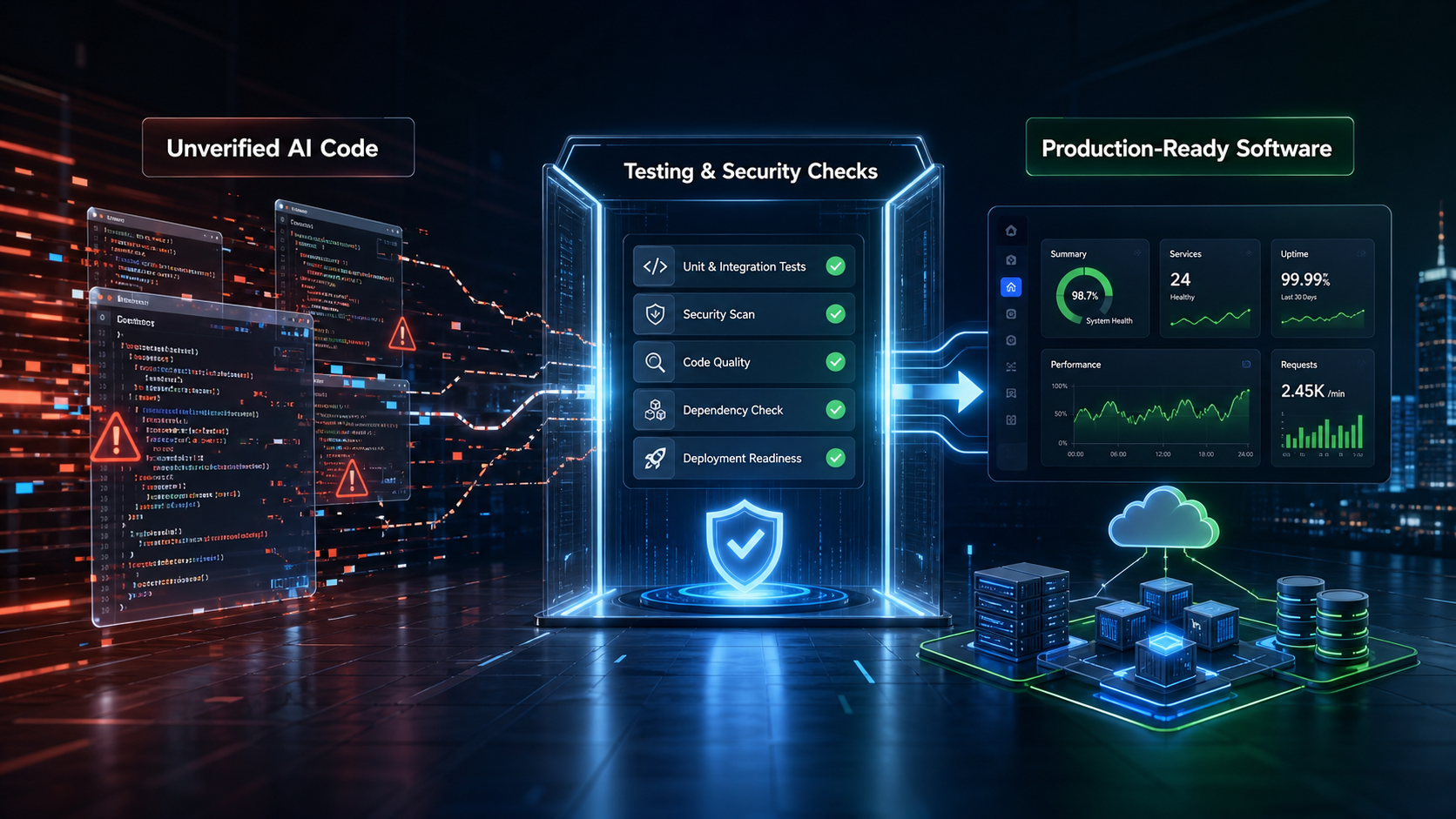
Why AI-Generated Code Fails in Production—And How to Prevent It
AI can write code faster than any engineering team could just a few years ago. That is the good news.
The bad news? Fast code isn't automatically reliable software.
Across startups, digital agencies, and enterprise teams, AI coding assistants are now used to build MVPs, dashboards, internal tools, and full-scale SaaS applications. While AI dramatically speeds up development and helps non-technical founders move from idea to prototype, many teams hit a painful wall: code that works flawlessly in a demo breaks the moment real users touch it.
This isn't because AI is useless—it is remarkably powerful. The issue is that raw AI-generated code fails when it is treated as finished software rather than one step in a comprehensive software development lifecycle.
Here is why AI-generated code breaks in production, and how Paranu bridges the gap between speed and software reliability.
The Root Cause: AI Code Lacks Production Context
Most AI-generated code fails in production for a simple reason: it is written in a vacuum.
An AI model responds to a prompt. It can generate a front-end screen, an API endpoint, a login flow, or a database schema. But enterprise-grade software requires far more than isolated prompts. Production software requires deep context:
User Personas: Who is using the software, and what are their exact permissions?
Business Rules: What must the product achieve beyond basic functionality?
Edge Cases & Failure Modes: What happens when an API drops, a payment fails, or a database throttles?
Data Integrity: How does data move securely across decoupled systems?
DevOps & Scalability: How will the software be deployed, monitored, and maintained?
When these structural details are missing from a prompt, AI fills the gaps with assumptions. Those assumptions might pass a quick visual test, but in production, they create critical bugs, severe security vulnerabilities, and expensive technical debt.
The Demo Illusion vs. Production Reality
AI-generated software often looks impressive at first glance. The UI renders, buttons respond, forms submit, and charts populate with dummy data. The product feels ready to launch.
However, a demo only proves that a single "happy path" works in a controlled environment. Production is a chaotic environment:
[ Controlled Demo ]   --> Works on 1 Happy Path (Dummy Data, Single User)
[ Production System ] --> Must Handle Messy Paths (Edge Cases, High Concurrency, Bad Data, Security Threats)
Real users enter malformed data. Third-party APIs rate-limit requests. Payment webhooks drop. Authentication tokens expire. Databases require clean relational structures and strict indexing.
A demo proves a concept; production requires resilience.
6 Common Reasons AI-Generated Code Fails in Production
To deploy reliable software, teams must understand where raw AI output consistently falls short:
1. Unclear Requirements & Vague Scope
If your prompt or product spec is vague, the resulting AI code will be vague too. AI may generate what sounds logical rather than what the business actually requires. This leads to omitted business logic, incomplete role-based access control (RBAC), and missing workflows.
2. Weak Architectural Integrity
AI excels at generating isolated code snippets, but production applications need components to integrate seamlessly. Without architectural guidance, AI produces fragmented code, duplicated logic, messy state management, and a fragile codebase that breaks whenever new features are added.
3. Missing or Superficial Testing
AI can generate functional code, but it rarely generates robust automated test suites unless explicitly directed and verified. Without unit tests, integration tests, and end-to-end (E2E) workflow checks, every new deployment runs the risk of breaking existing functionality.
4. Hidden Security Risks & Compliance Gaps
AI models frequently introduce insecure code patterns, weak authentication checks, hardcoded secrets, unsafe dependencies, or loose CORS policies. Because the UI looks polished, non-technical stakeholders often miss these deep security flaws during visual reviews.
5. Fragile Third-Party Integrations
Modern web applications rely on complex ecosystem integrations—Stripe, HubSpot, SendGrid, AWS S3, and external LLM APIs. AI tools routinely misunderstand complex API rate limits, webhooks, retries, and asynchronous failure states, leading to broken user flows during payment or data syncs.
6. Poor Deployment & DevOps Readiness
A local application running on localhost is not production-ready. Production requires environment variable management, database migration strategies, SSL certificates, error tracking (e.g., Sentry), automated backups, and CI/CD pipelines.
The Verification Gap in Modern Software Engineering
The primary bottleneck in modern software engineering is no longer code generation—it is code verification.
Industry research confirms this shift:
Sonar’s Developer Survey highlights that while AI-generated code accounts for a massive percentage of newly committed code, developer trust in raw AI output remains low.
New Relic’s State of AI Coding Report reveals a direct correlation between unverified AI code deployment and a rise in production incidents.
Key Takeaway: The faster AI generates code, the more critical structured review, automated testing, and operational discipline become.
Why Founders and Agencies Must Rethink AI Code
       [ Raw AI Code Output ]
                 │
                 ▼  (Unverified Deployment)
┌─────────────────────────────────────────┐
│         THE PRODUCTION CRISIS           │
├─────────────────────────────────────────┤
│ • Broken Sales Demos & Customer Churn   │
│ • Delayed Fundraising Rounds            │
│ • Client Escalations & Lost Trust       │
│ • Massive Technical Debt Before Launch  │
└─────────────────────────────────────────┘
For Startup Founders
A broken MVP damages customer trust, ruins investor demos, and stalls user validation. If users encounter bugs during onboarding, you won't know if your product concept failed or if your software simply broke. You don't need an over-engineered enterprise application, but you do need a dependable MVP that validates your core business hypothesis.
For Digital & Development Agencies
Clients expect faster delivery times because they know AI tools exist. However, if an agency ships fragile, unverified AI code that breaks post-launch, the client won't blame the AI—they will blame the agency. Agencies must combine the velocity of AI with rigorous quality assurance to protect their reputation and margins.
How Paranu Solves the AI Code Quality Problem
Paranu was built on a foundational principle: AI should accelerate software delivery, but production readiness must be engineered into the delivery pipeline.
Paranu does not treat raw AI code generation as the final step. Instead, it embeds AI within a complete, end-to-end software lifecycle:
1. Context-First Scope Definition
Before a line of code is generated, Paranu translates your idea into a production-grade blueprint—mapping user flows, screen states, database models, acceptance criteria, and architecture decisions.
2. AI-Orchestrated Delivery Pipeline
Paranu links planning, UI/UX design, frontend and backend development, testing, security audits, and DevOps into a single, cohesive system. Your software is architected systematically, not stitched together from disconnected code snippets.
3. Continuous Verification & Testing
Every feature is validated against the original specification. Paranu runs automated tests, security scans, and workflow verifications to ensure stability before deployment.
4. Interactive Review & Staging
Founders and agency teams receive a live, fully functional staging environment to test real workflows, request revisions, and validate performance prior to final sign-off.
5. Full Source Code Ownership & No Vendor Lock-In
You retain 100% ownership of your IP. Paranu provides clean source code, Git repository exports, deployment configurations, and complete technical documentation so your team can scale the software seamlessly in the future.
The Future of Software: AI-Orchestrated Delivery
The solution to fragile AI code is not to avoid AI tools—it is to stop treating raw AI output as production-ready software.
AI provides the speed; structured engineering processes provide the reliability.
Modern Software Delivery = AI-Accelerated Velocity + Structured Human-Grade Verification
Founders launch faster without becoming technical project managers.
Agencies scale delivery capacity while maintaining quality standards.
Businesses innovate rapidly without building on technical debt.
Build Software Users Can Actually Trust
AI-generated code fails in production when speed is the only metric that matters. But when AI execution is guided by clear scoping, sound architecture, rigorous testing, security controls, and clean deployment pipelines, it becomes an unbeatable competitive advantage.
Don't stop at generated code—launch production-ready software.
Discover how Paranu turns your software ideas into reliable, scalable applications today.